


Yoga Therapy and Diabetes
A compassionate, personalised approach to yoga therapy—supporting people with diabetes to feel safe, confident, and at ease in their bodies.
I often begin my classes with a simple question:
“How are you today?”
Not everyone answers out loud—but everyone pauses. Because for many of us, especially those living with diabetes, the answer is never just physical. It’s energy, emotions, numbers, and the unseen balance we carry within.
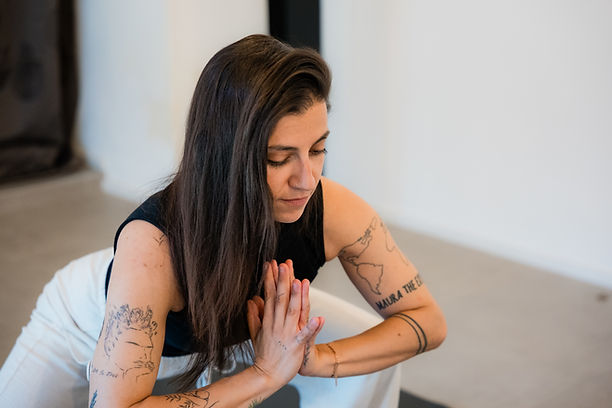
My Story
I have been living with Type 1 Diabetes since 2003. Through my teenage years, into adulthood, and now as a yoga therapist, I’ve learned that balance is not something you achieve once—it’s something you continuously respond to. The daily rhythm of Hypoglycemia and Hyperglycemia is always there, quietly shaping how I move, feel, and show up.
When I first came to yoga, I was searching for space. Space to breathe, to reconnect, to feel at home in my body again. But practicing yoga with diabetes—especially while wearing an insulin pump—can be a very different experience than what most people imagine.
I remember standing in changing rooms, unsure of what to do with my pump.
Should I clip it? Hide it? Tuck it into my clothing and hope it wouldn’t show?
I remember adjusting it during class, worried someone might notice.
Feeling exposed. Different. Embarrassed.
For the first five years of practicing yoga, I would take it off completely for 60–90 minutes—just to get through a class without feeling uncomfortable. Often, I chose to practice alone at home instead, following online classes, because I didn’t want anyone to adjust me or touch me without understanding my situation.
And even later, as a teacher, for the first four years I continued doing the same—quietly disconnecting, trying to fit into a space that didn’t yet feel like it could hold all of me.
Sometimes I didn’t know how to move freely without thinking about the tubing, the placement, the visibility. There were moments I avoided certain postures—not because my body couldn’t do them, but because I didn’t feel comfortable in my own skin.
And then there was the fear beneath it all—
What if my levels drop? What if I need to stop? What if I draw attention?
I remember one moment clearly. I informed a teacher that my glucose levels were dropping. I needed to pause, to take care of myself. Instead of support, I was asked to leave the class because it was considered “disruptive.”
That experience stayed with me.
Not as something that pushed me away from yoga—but as something that reshaped my path within it.
It led me to Yoga Therapy—a more compassionate, individualized approach that recognises that every body is different, and every condition deserves understanding.
Today, my teaching reflects both my professional training and my personal experience.
I work with a wide range of students, including seniors aged 80+, which has deepened my ability to adapt yoga in a safe, accessible, and supportive way. I specialise in a therapeutic and personalised approach, with a particular focus on supporting people living with diabetes—both Type 1 Diabetes and Type 2 Diabetes.
In my sessions, there is no expectation to hide anything.
No pressure to “fit in.”
You can wear your pump however feels right.
You can pause when you need to.
You can check your levels without explanation.
Instead, we focus on awareness.
We adapt movement.
We use breath to regulate the nervous system.
We create space for rest when it’s needed.
Because managing diabetes is not just about numbers—it’s about how you feel in your body.
Yoga therapy can be offered in a way that truly supports you—whether in a one-to-one setting, where everything is tailored specifically to your needs, or in small group sessions upon request, where a shared experience can also bring connection and reassurance.
I understand the hesitation that can come with entering a yoga space. The concerns around blood sugar levels, the visibility of devices, the uncertainty of how your body will respond. My aim is to create an environment where none of that has to be hidden—where you feel safe, supported, and seen.
Yoga, in this context, is not about performance.
It is about meeting yourself exactly where you are—on that day, in that moment.
For me, yoga became more than a practice. It became a way to live with diabetes—not in resistance, but with awareness, compassion, and balance.
And that is what I offer to others.
Yoga Therapy, Anxiety & Depression
A gentle, therapeutic approach to yoga that supports anxiety, burnout, and emotional wellbeing through breath, movement, and nervous system regulation.
There was a time when my mornings didn’t begin with presence—but with pressure.
Before even getting out of bed, I would reach for my phone. Notifications, messages, social media—my mind already racing, my body already tense. It felt like my nervous system never had a chance to rest. Living and working in a fast-paced environment like London, constantly overworked and overstimulated, I didn’t realise how far I had drifted from myself.

My Story
Over time, the anxiety became constant.
A quiet hum in the background… until it wasn’t quiet anymore.
Burnout didn’t arrive all at once. It built slowly—through exhaustion, stress, and the feeling of always having to keep going. Until one day, my body simply said no. I could no longer function the way I used to. My body was telling me something I had been ignoring for too long:
It’s time to get healthy.
As someone living with Type 1 Diabetes, I also came to understand how deeply connected my mental and physical health are. The constant need to monitor, respond, and manage means we rarely switch off completely. That ongoing vigilance can fuel anxiety—and at times, depression.
There are still moments today when I feel it.
The heaviness. The overwhelm. The unpredictability.
Because the truth is—some thoughts we cannot control.
But we can learn how to meet them.
This is where yoga became something much deeper for me.
Through breathwork, especially Pranayama, I found a way to create space within moments of anxiety. A way to slow down my system when everything felt too fast. Simple practices—like lengthening the exhale, breathing through the nose, or placing a hand on the body—became anchors I could return to, again and again.
Meditation taught me how to observe rather than react.
Noticing thoughts without being pulled into them.
Creating just enough distance to feel less overwhelmed.
Mindful movement helped me reconnect with my body—not as something under pressure, but as something I could feel safe in again. Gentle, repetitive movements, longer holds, and supported postures began to calm my nervous system rather than stimulate it.
Rest became a practice too.
Learning to lie down without guilt.
Allowing the body to soften.
Giving the nervous system permission to switch off.
Not to eliminate anxiety—but to support myself through it.
This naturally led me further into Yoga Therapy, where these tools are used in a structured, therapeutic way to support mental health.
In this work, we don’t push feelings away.
We build awareness.
We create safety in the body.
We learn how to regulate the nervous system gently and sustainably.
Yoga therapy offers practical tools for moments of anxiety, for periods of low mood, for burnout and overwhelm—tools that I have lived, practiced, and now share with others. It’s not about fixing everything, but about creating small, consistent shifts that help you feel more grounded, more supported, and more in control.
Because healing doesn’t come from doing more.
Sometimes, it begins with learning how to pause.